
Opal & Pink Tourmaline: October's Two Birthstones
Posted by The Karat 22 Gemology Team on Oct 10th 2026
One stone holds a rainbow. The other blushes in the light. October is the only month that gets both.
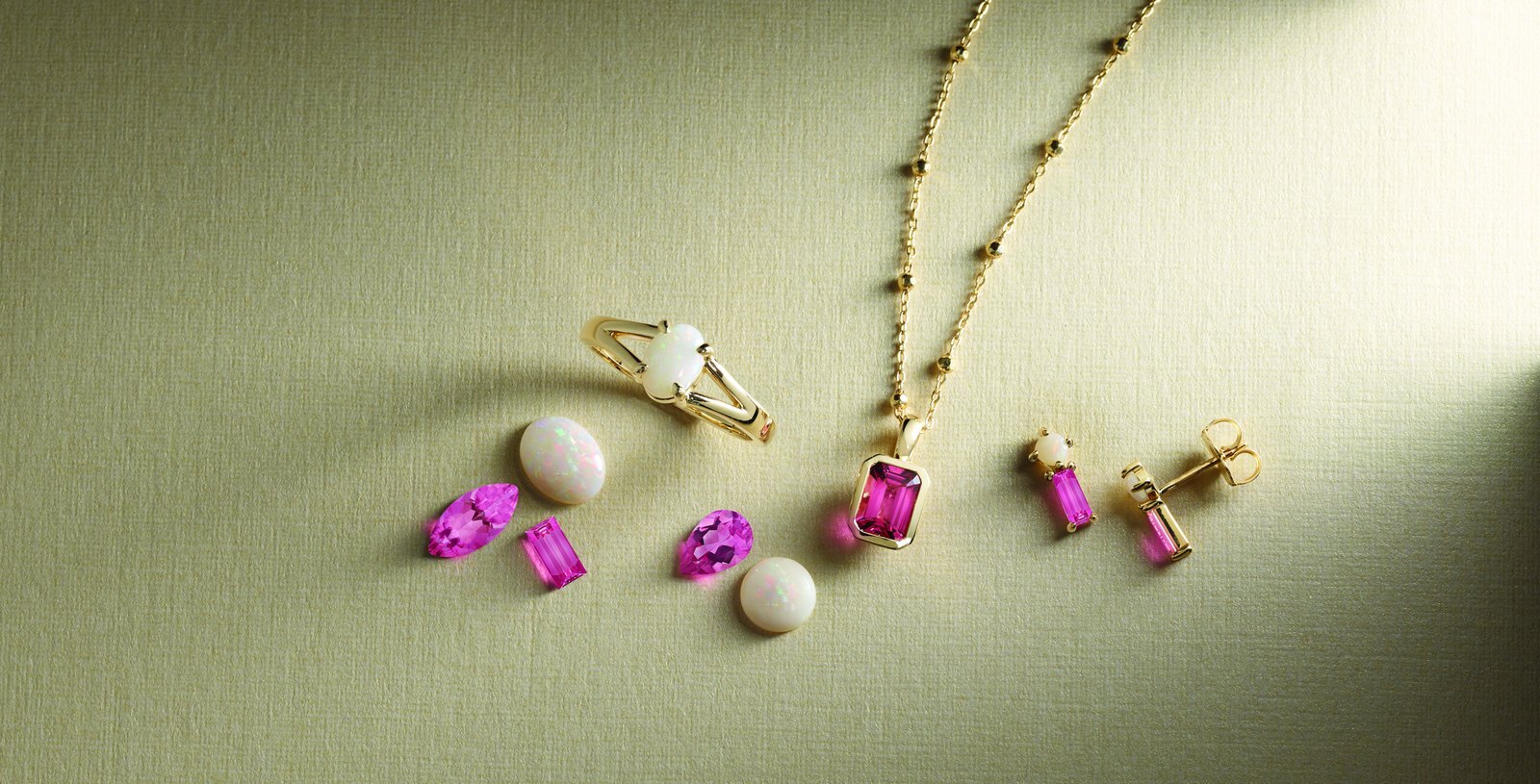
Most months have one birthstone. A few have two because the list was revised at some point and nobody wanted to lose the old favourite. October’s pair is different. Opal and pink tourmaline are nothing alike. One is soft, full of water and famously temperamental. The other is hard, crystalline and almost impossible to fault. Opal’s colour changes as you move. Tourmaline’s stays put but comes in more shades than any other gem.
If you were born in October, you get to choose between them. If you are buying for someone born in October, knowing why they are so different will help you choose well. This article covers the gemology, the history (including an opal superstition caused by a single novel), what each stone means in Indian tradition, how to care for each one, and the pieces in our Houston case this month.
In brief
October has two birthstones: opal and pink tourmaline. Opal has been October’s stone since the first standardised American list in 1912. Pink tourmaline was added as the modern alternate in 1952.
Opal is hardened silica gel that still holds water, typically 5 to 20 percent of its weight. Its flashes of colour, called play-of-colour, come from microscopic spheres of silica stacked in rows that split light like a prism. It rates 5.5 to 6.5 on the Mohs scale, so it needs gentle care.
Pink tourmaline is a crystal that rates 7 to 7.5 on the Mohs scale and is easy to wear every day. Opal is the traditional gem for the 14th wedding anniversary, and tourmaline for the 8th.
Why October has two birthstones
The birthstone list most Americans know dates from 1912, when the National Association of Jewelers agreed on one stone for each month. Opal was October’s. In 1952 the Jewelry Industry Council of America revised the list and added pink tourmaline as an alternate.
The official reason was choice. The practical reason is clear once you hold both. Opal is beautiful but fragile. It doesn’t suit everyone or every piece of jewelry. Pink tourmaline gave October a stone you can set in a ring and stop worrying about.
Either one is a correct October birthstone. Some clients wear both, and the two look surprisingly good together. The milky white of opal makes the pink look warmer, and the pink brings out the rose flashes in the opal.
Opal: the stone that holds a rainbow
What you are actually looking at
Most gems are crystals: atoms locked in a repeating pattern. Opal isn’t. It formed when water carrying dissolved silica seeped into cracks in rock, then slowly evaporated over millions of years and left behind a hardened silica gel. The water never fully left. Opal typically still holds 5 to 20 percent water by weight, which is the key to both its beauty and its care.
The flashes of colour come from tiny spheres of silica, far too small to see, settled into neat rows like oranges stacked in a crate. When light passes between the rows it splits into colours, just as it does through a prism or across a soap bubble. Smaller spheres produce blues and greens. Larger, rarer spheres produce oranges and reds. That is why an opal with strong red flashes is worth far more than one that only shows blue. Scientists in Australia confirmed this structure in the 1960s, when electron microscopes finally made the spheres visible.
This also explains why no two opals look the same, and why the same opal changes as you tilt it. You aren’t seeing pigment. You are seeing light being sorted as it passes through.
An opal has no colour of its own. Everything you see is light, rearranged.
The kinds of opal you will meet
- White or light opal: flashes of colour over a milky white body. This is the classic October look, and the opal you will find in most birthstone jewelry.
- Black opal: flashes over a dark body, which makes the colours look almost electric. It is the rarest and most valuable type, mined chiefly at Lightning Ridge in New South Wales.
- Boulder opal: opal still attached to its brown ironstone host rock, often cut to keep the two together.
- Fire opal: transparent orange to red opal, mostly from Mexico. It may show no flashes at all and is valued for its colour.
- Ethiopian opal: a newer source since the late 2000s, often vivid and well priced. Much of it is hydrophane, meaning it can absorb water and temporarily turn clear or change colour. Good to know before you wash your hands while wearing it.
Australia has supplied most of the world’s precious opal since the 1890s. Many of the pieces in this month’s collection use opal inlay: thin slices of opal cut and fitted into gold channels, a little like stained glass. It is a classic technique of American jewelry houses such as Kabana, and it puts a large, uninterrupted field of colour on a ring or bangle that a single cabochon couldn’t give you.
The novel that made opal “unlucky”
For most of history opal was considered the luckiest of stones. The Romans prized it above almost everything else because it seemed to contain every other gem’s colour at once. Medieval Europeans believed it protected eyesight.
The bad reputation dates to 1829 and a single book. In Sir Walter Scott’s novel Anne of Geierstein, a character wears an opal that changes with her moods. A few drops of holy water put out its fire, and she dies soon afterwards. Readers took it as a warning, and opal sales in Europe reportedly fell by half within a year.
It took decades and the great Australian finds of the 1890s to restore opal’s standing. The superstition is fiction, and it always was. It is still worth knowing about, because someone will mention it the first time you wear an opal, and now you will know where it came from.
Opal in Indian tradition
Many of our clients ask a different question about opal: what does it mean in Jyotish?
In Vedic astrology, opal is associated with Shukra, the planet Venus, which governs love, beauty, art, comfort and prosperity. Diamond is the principal gem for Venus. Opal is widely regarded as its uparatna, or substitute gem, and many astrologers suggest it as a gentler, more accessible way to strengthen Venus. It is traditionally set in silver or gold and worn on a Friday, the day associated with Shukra.
We are jewelers, not astrologers. If you are buying opal for astrological reasons, please consult your own pandit about weight, metal and timing, as recommendations vary. What we can tell you is that it makes October an especially fitting month to give opal: Venus is associated with beauty and prosperity, and Dhanteras and Diwali, the season of gold and new beginnings, arrive just weeks later.
Pink tourmaline: the gem of many colours
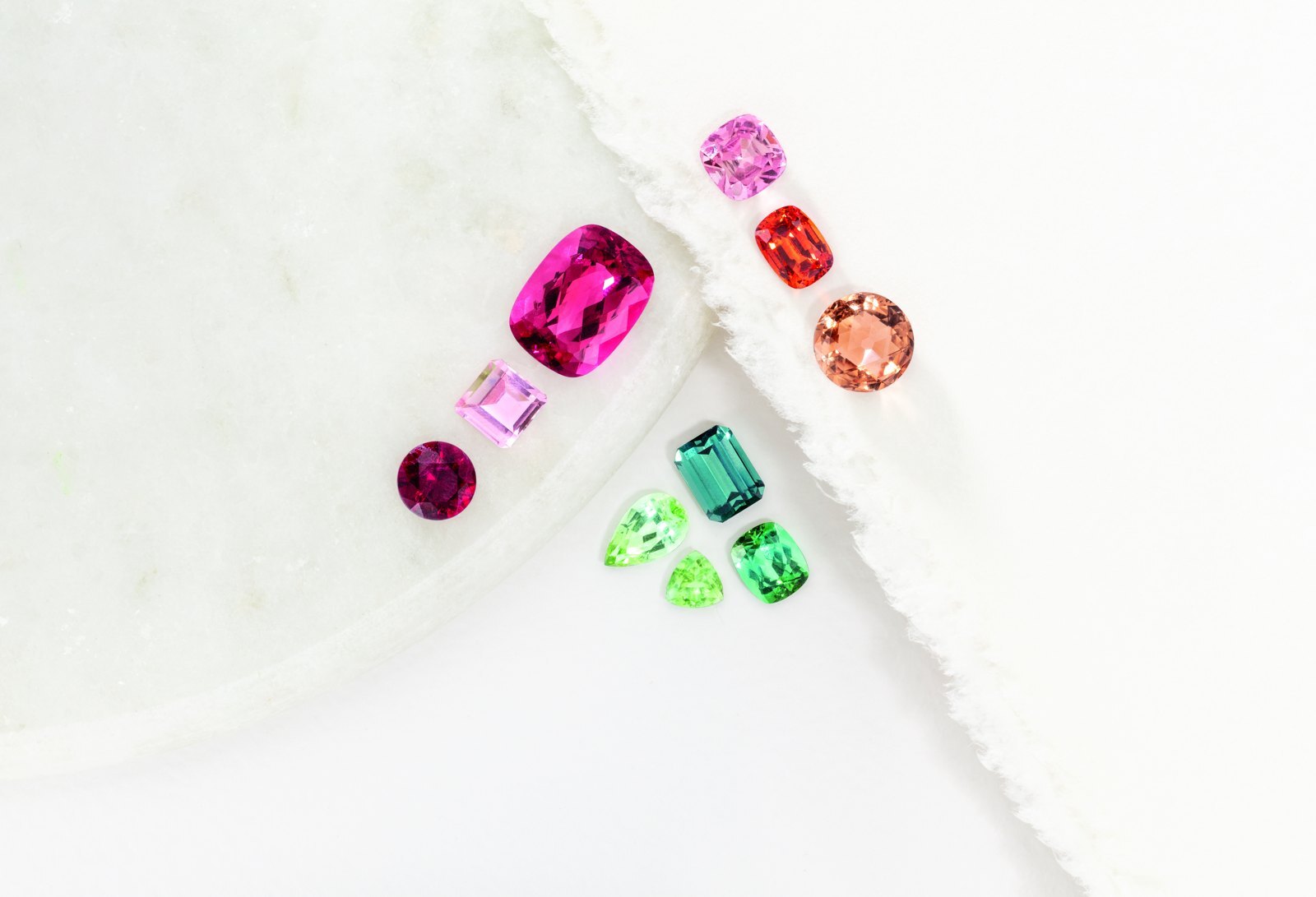
The name comes from the Sinhalese word toramalli, meaning “mixed gems.” Dutch merchants used it for the colourful water-worn pebbles they bought in Ceylon, now Sri Lanka, without realising that many of those pebbles were the same mineral in different colours. Tourmaline comes in more colours than any other gemstone, sometimes several in one crystal. “Watermelon” tourmaline is pink at the heart and green at the rind.
Pink tourmaline gets its colour from traces of manganese. The range runs from barely-there blush to deep, saturated pinkish red. The richest of those reds are often sold as rubellite.
A Chinese empress and a California mine
The most surprising chapter in pink tourmaline’s history runs through San Diego County. In the late 1800s, mines near Pala, California, began producing fine pink and red tourmaline. The biggest buyer was China, where Empress Dowager Cixi was especially fond of the colour. Much of the California production was shipped across the Pacific and carved into snuff bottles and ornaments for the imperial court. When the Qing dynasty fell in 1912, the American tourmaline trade collapsed with it.
The stone that pulls ash from a pipe
Tourmaline also has a curious physical property. When it is heated or squeezed, it develops an electrical charge, with one end of the crystal positive and the other negative. Dutch traders noticed that warmed tourmaline would attract dust and ash, and used it to clean out their pipes. Scientists call it pyroelectricity. To a jeweler, it is just one more thing that makes tourmaline unusual.
For wearing, the important number is 7 to 7.5 on the Mohs scale. Pink tourmaline is hard enough for rings, bracelets and everyday pieces. Unlike opal, it holds no water and doesn’t mind changes in temperature. If opal is the stone you save for evenings, tourmaline is the one you can wear every day.
| Property | Opal | Pink tourmaline |
|---|---|---|
| What it is | Hydrated silica, non-crystalline | Complex borosilicate crystal |
| Hardness (Mohs) | 5.5 – 6.5 | 7 – 7.5 |
| Water content | Typically 5 – 20% | None |
| Source of colour | Light diffracted by silica spheres | Trace manganese |
| Main sources | Australia, Ethiopia, Mexico | Brazil, Africa, Afghanistan, California |
| Everyday wear | Pendants and earrings; rings with care | Excellent, including rings |
| Anniversary | 14th | 8th |
| Jyotish association | Venus (Shukra), as uparatna | — |
The October collection
This month’s case is a mix of things we rarely get to show together: two traditional 22K yellow gold opal pieces, a run of signed American opal-inlay pieces, and two multi-colour tourmaline pieces that bring the pink in. Several of the inlay pieces are currently offered well below their original price.
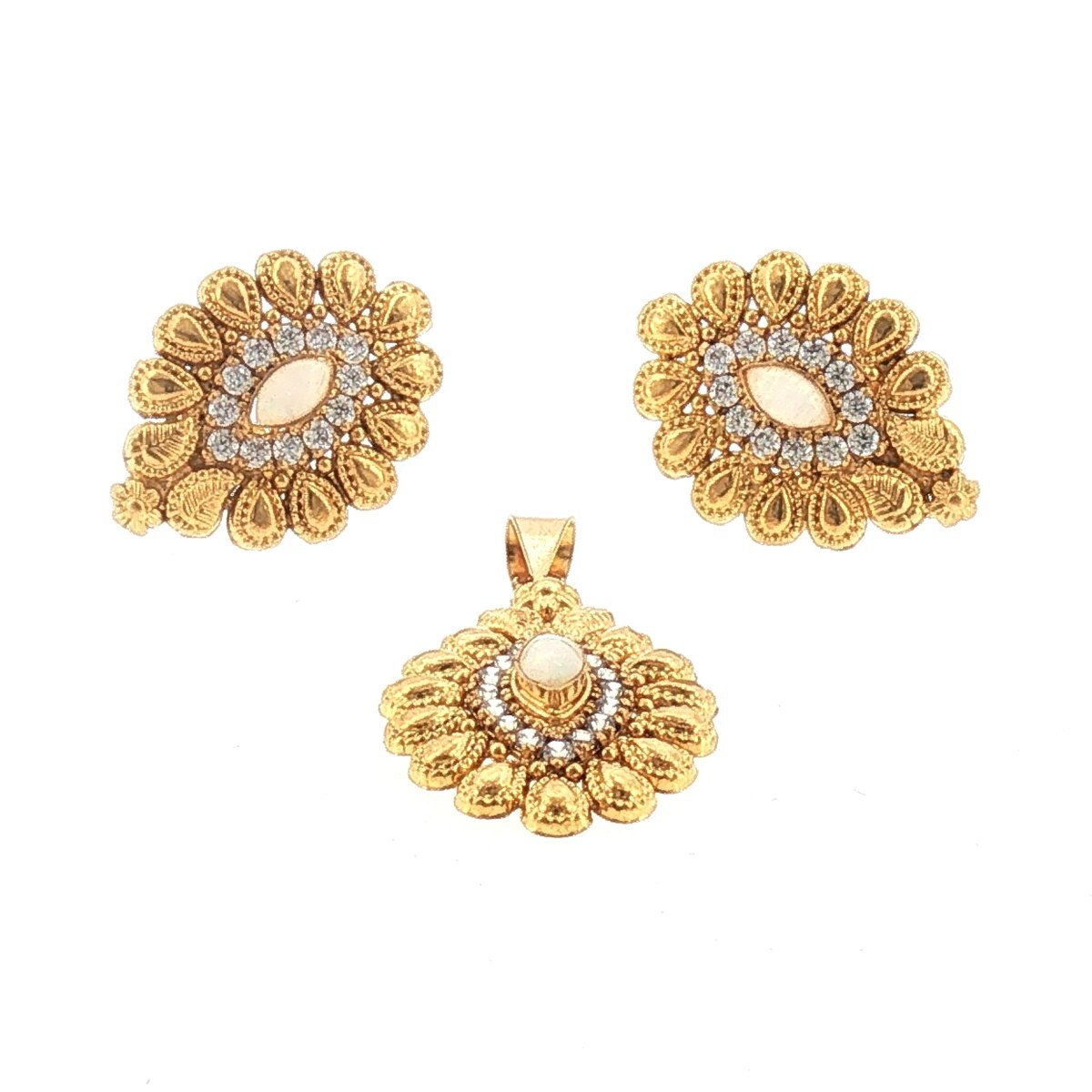
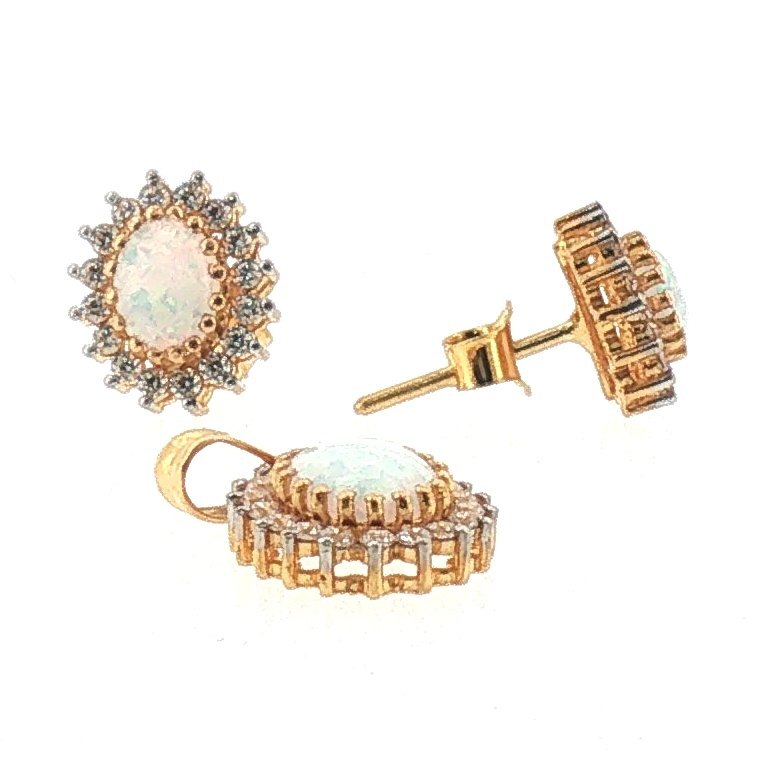
Opal Floral Stud Earrings & Pendant Set — 22K yellow gold
This set belongs at a wedding or on Diwali night. Oval opal centres sit in a halo of white accent stones, surrounded by layers of textured gold petals. The opal’s soft glow tempers what would otherwise be a very bold amount of gold. In 22-karat gold, with the deep, warm colour our clients know, it is the most traditional piece in the collection and the easiest to wear with a saree or lehenga.
$1,925. View this set
Oval Opal Halo Pendant — 22K yellow gold
If you are buying a first opal, or a birthday gift for someone born in October, start here. A single oval opal sits in a sunburst halo on a fine chain. It is easy to wear every day, and a pendant is the safest setting for an opal because it rarely knocks against anything.
$1,875. View this piece
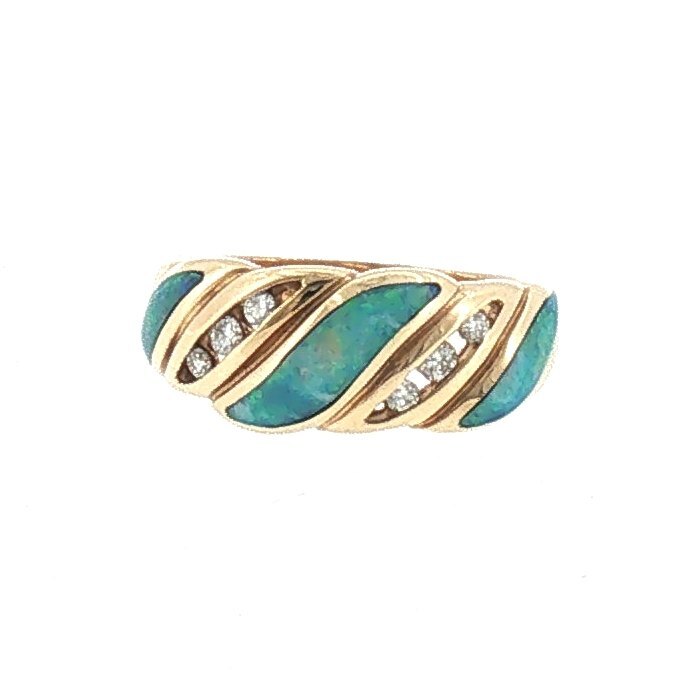
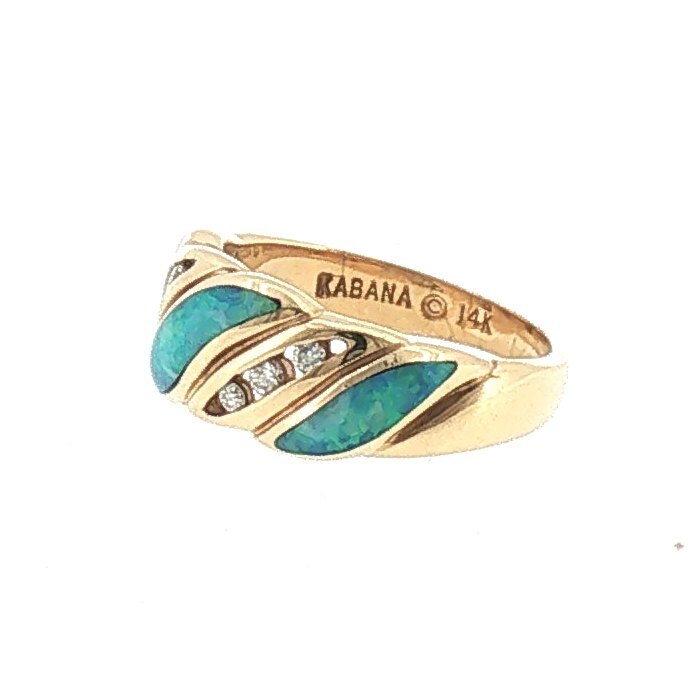
Kabana Triple Curved Opal Inlay & Diamond Ring — 14K yellow gold
Kabana has been setting opal inlay in gold since the 1970s, and this ring shows why the house is known for it. Three sweeping bands of blue-green opal flash turquoise and green as your hand moves, separated by ribbons of polished gold and 0.16 carats of channel-set diamonds. It makes a statement without needing a large centre stone.
$11,700, originally $19,500. View this piece
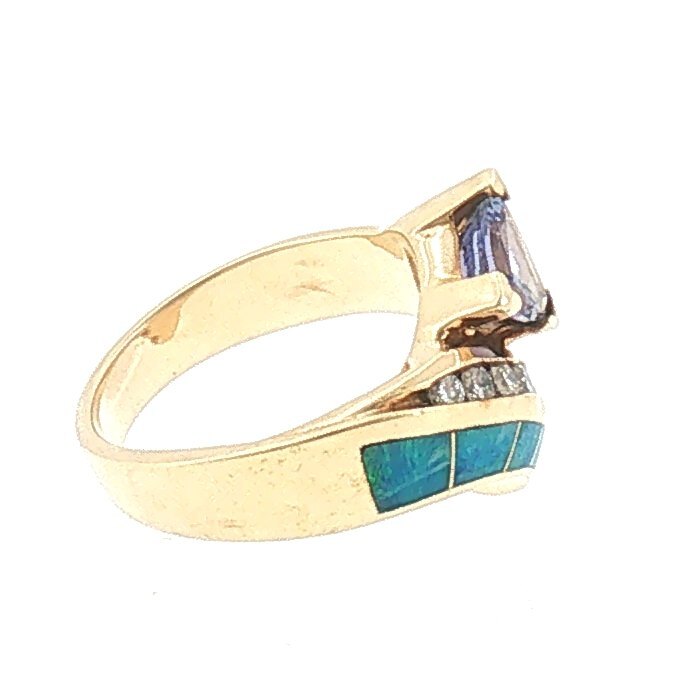
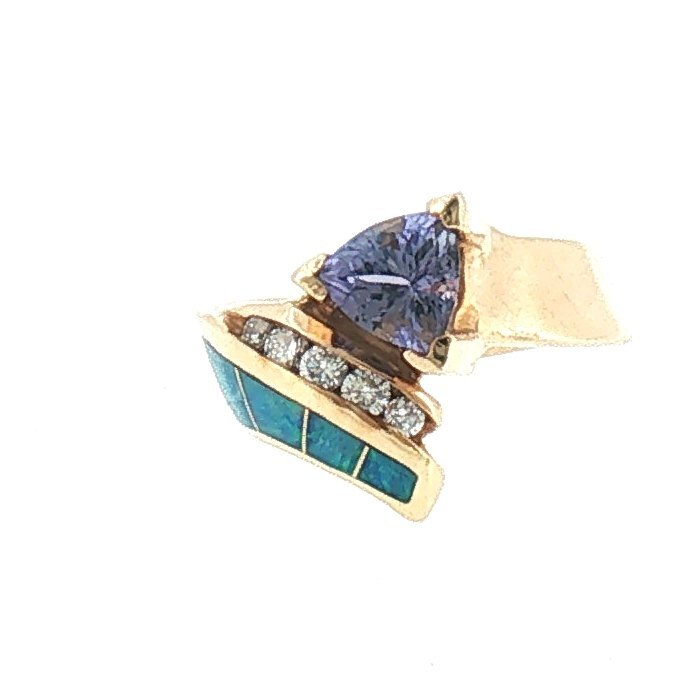
Trillion Tanzanite, Opal Inlay & Diamond Cocktail Ring — 14K yellow gold
This is the boldest ring in the collection. A violet-blue trillion tanzanite sits above a curved row of diamonds, with opal inlay sweeping along the side. Tanzanite is the December birthstone, so this is a natural choice for a couple born in October and December, or for anyone who loves blue.
$14,700, originally $24,500. View this piece
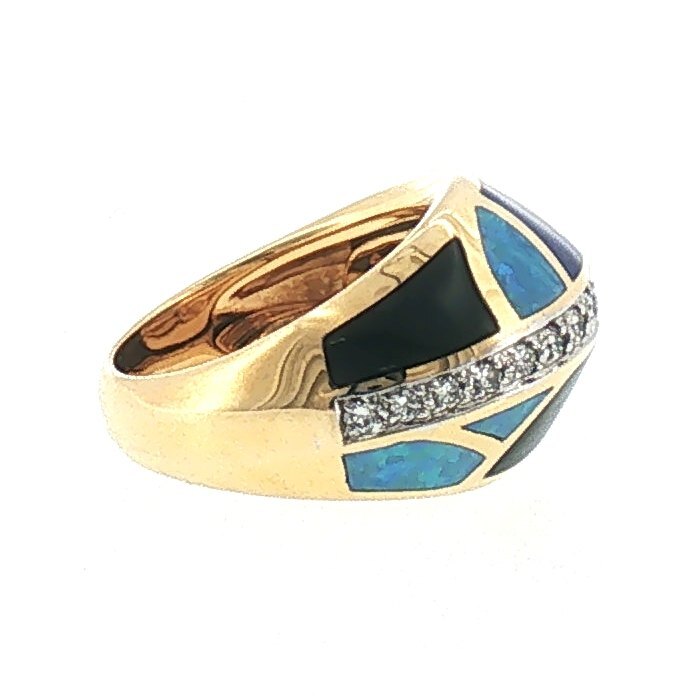
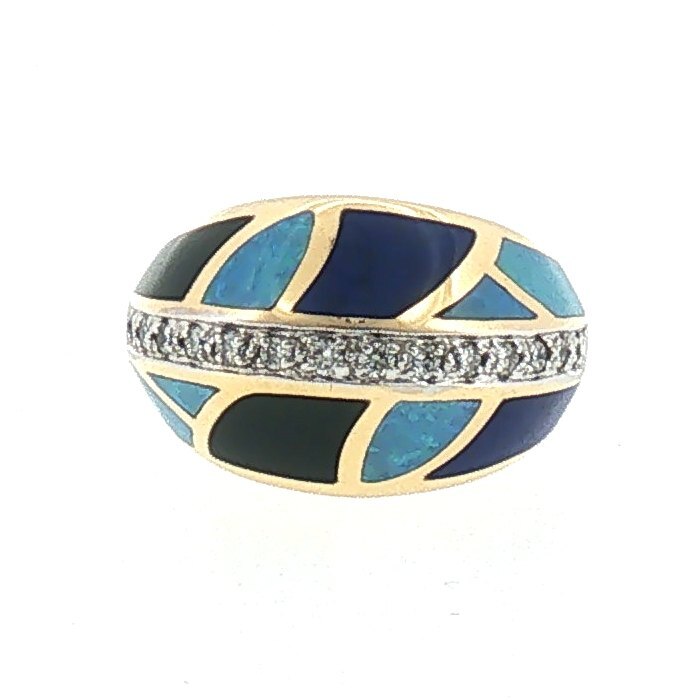
Asch Grossbardt Multi-Stone Inlay Ring — 14K gold
Each stone in this mosaic is cut by hand and fitted between gold borders: opal, deep blue lapis, black onyx and mother-of-pearl, with a row of 0.15 carats of diamonds through the centre. The ring weighs 9.7 grams and has the feel of a piece made to be kept. This is wearable art, with the opal as one colour among several.
$8,375, originally $13,950. View this piece
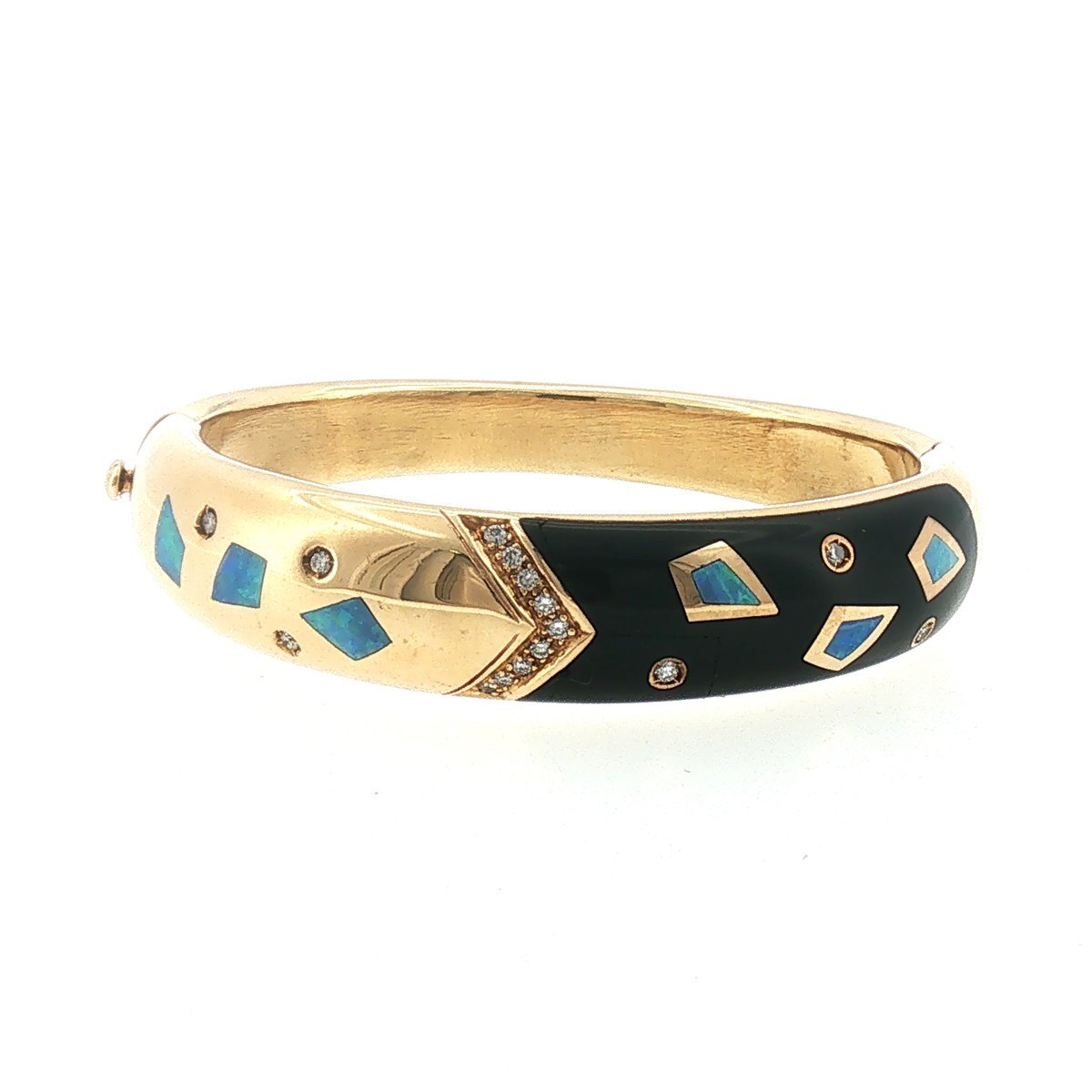
Yellow Gold & Black Enamel Bangle with Geometric Opal Inlays — 14K
This is the showpiece of the collection, at 49.6 grams of 14K yellow gold. A panel of glossy black enamel sets off blue-green opal shapes, each framed in gold, so the opal looks even brighter. The bangle is hinged for an easy, secure fit. It suits someone who likes jewelry with a strong graphic look.
$23,700, originally $39,500. View this piece
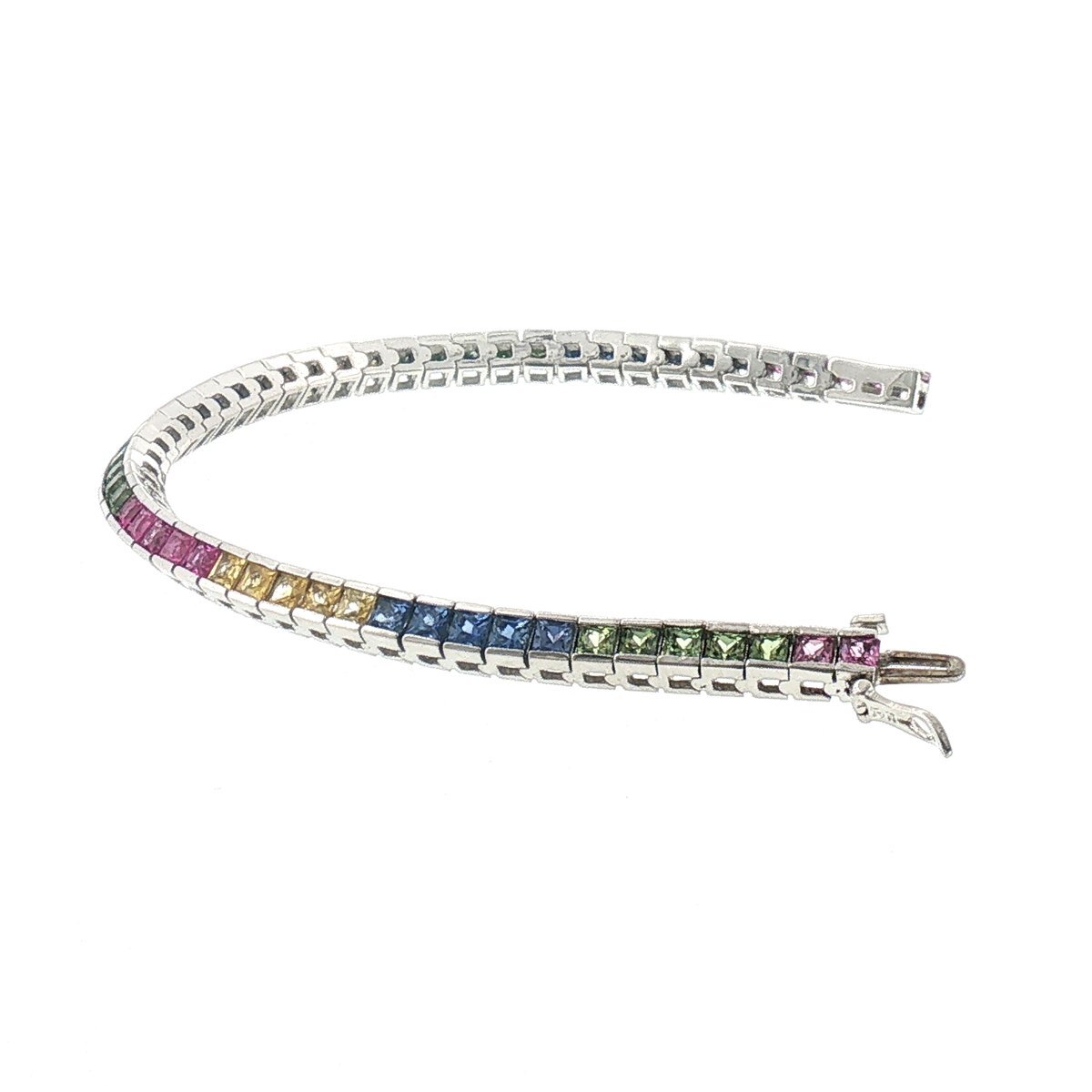
Multi-Colour Tourmaline Tennis Bracelet, 14K white gold: 8.00 carats of square-cut tourmaline in pink, blue, green and golden yellow, 18.6 grams. $5,700, originally $9,500. View this piece
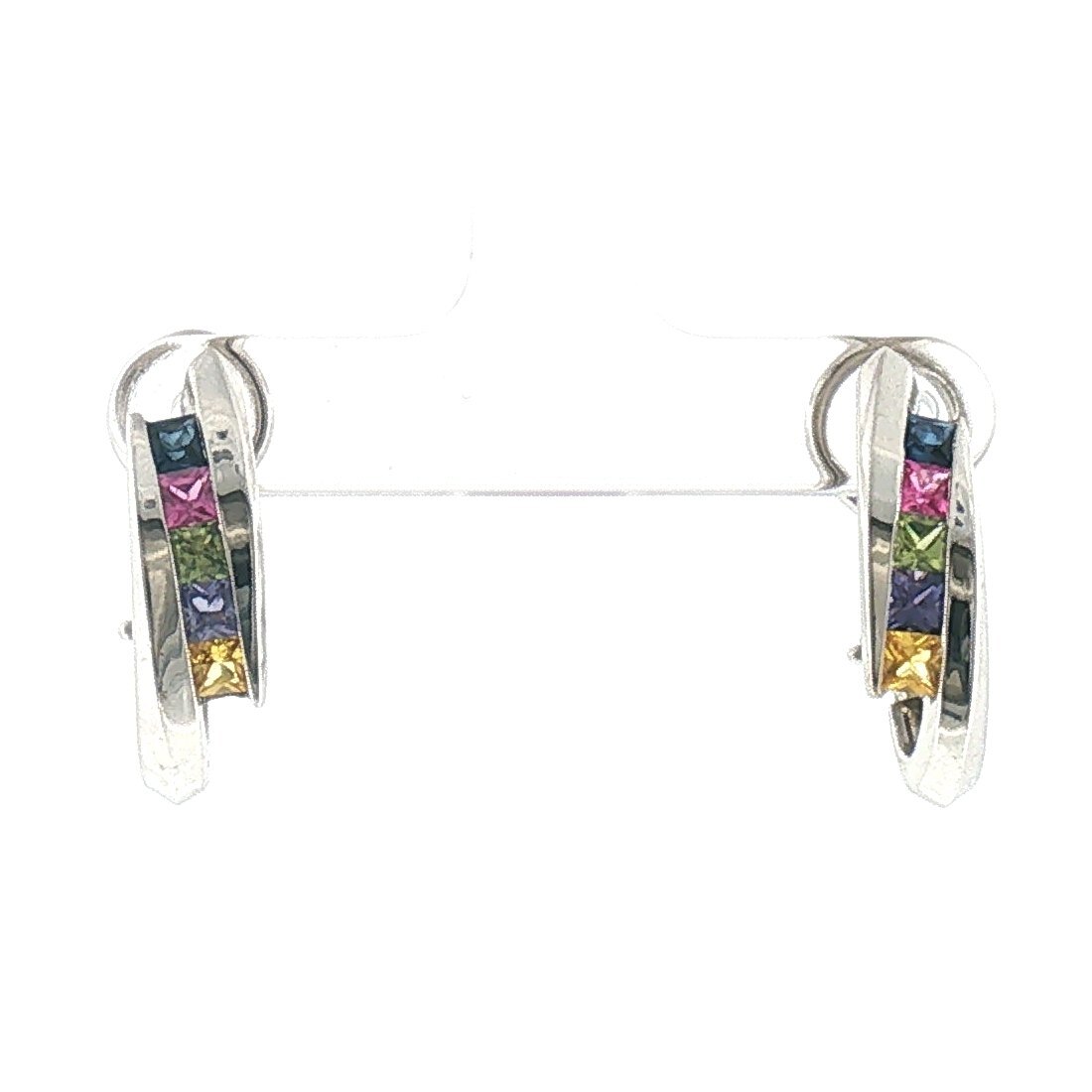
Multi-Colour Tourmaline Channel-Set Hoops, 14K white gold: 1.50 carats, the easiest way to wear October’s second birthstone every day. $1,650, originally $2,750. View this piece
| Piece | Metal | Price |
|---|---|---|
| Multi-Colour Tourmaline Channel-Set Hoops | 14K white gold | $1,650 |
| Oval Opal Halo Pendant | 22K yellow gold | $1,875 |
| Opal Floral Stud Earrings & Pendant Set | 22K yellow gold | $1,925 |
| Multi-Colour Tourmaline Tennis Bracelet | 14K white gold | $5,700 |
| Asch Grossbardt Multi-Stone Inlay Ring | 14K yellow gold | $8,375 |
| Kabana Triple Curved Opal Inlay Ring | 14K yellow gold | $11,700 |
| Trillion Tanzanite & Opal Inlay Cocktail Ring | 14K yellow gold | $14,700 |
| Black Enamel Bangle with Geometric Opal Inlays | 14K yellow gold | $23,700 |
Caring for opal and tourmaline
With these two stones, care is where the difference really shows. Tourmaline asks for very little. Opal asks for some attention, because of the water it holds and, in inlay pieces, because of how it is set.
Do
- Clean opal with a soft cloth, lukewarm water and a drop of mild soap, then dry it straight away
- Put opal on last, after perfume, lotion and hairspray
- Store opal on its own, in a soft pouch, away from harder gems that can scratch it
- Clean tourmaline with warm soapy water and a soft brush, which is always safe
Avoid
- Ultrasonic and steam cleaners for opal and opal inlay. Vibration and heat can crack the stone or loosen the inlay
- Soaking inlay pieces or wearing them in a pool, hot tub or while doing dishes
- Sudden temperature changes, such as a hot car or direct heat, which can dry opal too quickly and cause fine cracks
- Steam and sudden heat for tourmaline, too: it is durable, but it reacts to heat
In short, treat opal as you would a fine silk scarf. Wear it often, but take it off for the gym, the kitchen and the pool. Bring any inlay piece in once a year and we will check it at no charge.
Which one should you choose?
A simple rule from our sales floor: choose opal for pieces that are seen, and tourmaline for pieces that are worn hard. Opal pendants and earrings are ideal because they rarely take a knock. Opal rings are lovely, but a ring is the piece most likely to hit a door frame, so choose inlay or a protective setting if it will be worn daily. Pink tourmaline can go anywhere, including a ring worn every day of the week.
For a 14th anniversary, opal is the traditional gem. For an 8th, it is tourmaline. As with all anniversary charts, these are customs developed by the jewelry industry rather than rules. A piece that combines both stones works for either.
Questions we are asked about October’s birthstones
What is the birthstone for October?
October has two birthstones: opal and pink tourmaline. Opal has been the October birthstone since the first standardised American list in 1912. Pink tourmaline was added as the modern alternate in 1952. Either is correct, and many people wear both.
Why does opal show so many colours?
Precious opal is built from microscopic silica spheres stacked in orderly rows. Light passing between the rows is split into spectral colours, an effect called play-of-colour. Smaller spheres produce blue and green, and larger spheres produce orange and red, which is why red flashes are the rarest and most valuable.
Is opal durable enough to wear every day?
Opal rates 5.5 to 6.5 on the Mohs scale and contains water, so it is softer and more sensitive than most gems. It is ideal for pendants and earrings. Opal rings can be worn regularly if they are removed for housework, sport and swimming. Inlay settings, where the opal sits flush inside gold channels, offer more protection than a raised cabochon.
Is opal bad luck?
No. The superstition traces back to Sir Walter Scott’s 1829 novel Anne of Geierstein, in which a character’s opal loses its fire and she dies. European opal sales reportedly fell by half afterwards. Before that, opal was considered one of the luckiest gems, and the Romans prized it above most others.
What does opal mean in Vedic astrology?
In Jyotish, opal is associated with Shukra, the planet Venus, which governs love, beauty, art and prosperity. It is widely regarded as the uparatna, or substitute gem, for diamond, and is often suggested as a gentler way to strengthen Venus. Recommendations on weight, metal and timing vary, so consult your own astrologer.
How do you clean opal jewelry?
Use a soft cloth, lukewarm water and a little mild soap, then dry it immediately. Never use ultrasonic or steam cleaners on opal or opal inlay, and do not soak it. Avoid sudden temperature changes, which can cause fine cracks called crazing.
Is pink tourmaline durable?
Yes. Pink tourmaline rates 7 to 7.5 on the Mohs scale, contains no water and is suitable for rings and everyday jewelry. Clean it with warm soapy water and a soft brush. Avoid steam cleaners and sudden heat.
Which anniversary are opal and tourmaline for?
Opal is the traditional gem for the 14th wedding anniversary, and tourmaline for the 8th. Anniversary gemstone lists are industry customs rather than formal standards, so either stone, or a piece combining both, is a thoughtful choice.
How much does opal jewelry cost at Karat 22?
At Karat 22 Jewelers in Houston, the October collection runs from $1,650 for multi-colour tourmaline hoop earrings and $1,875 for a 22K yellow gold oval opal halo pendant, to $23,700 for a 14K yellow gold enamel bangle with geometric opal inlays. Several signed opal-inlay pieces are currently offered well below their original prices.
Where can I buy opal jewelry in Houston?
Karat 22 Jewelers carries opal and tourmaline jewelry at 5623 Hillcroft Avenue, Houston, Texas 77036, and has served Houston since 1983. The showroom is open Monday and Wednesday to Saturday from 11:30 am to 6:30 pm, and Sunday from 12 to 6 pm.
Serving Houston since 1983
See the fire move
Opal is the one gem a photograph cannot do justice to. Its colour only exists when the stone moves, and a screen cannot move with you.
Our October opal and tourmaline pieces are in the case now at Karat 22 Jewelers, 5623 Hillcroft Avenue, Houston. Come in, tilt one in the light, and let the stone show you what we mean.